South Africans are being bombarded with billions of spam and scam calls, with the latest figures showing that the problem is getting worse despite efforts by authorities and technology companies to fight back.
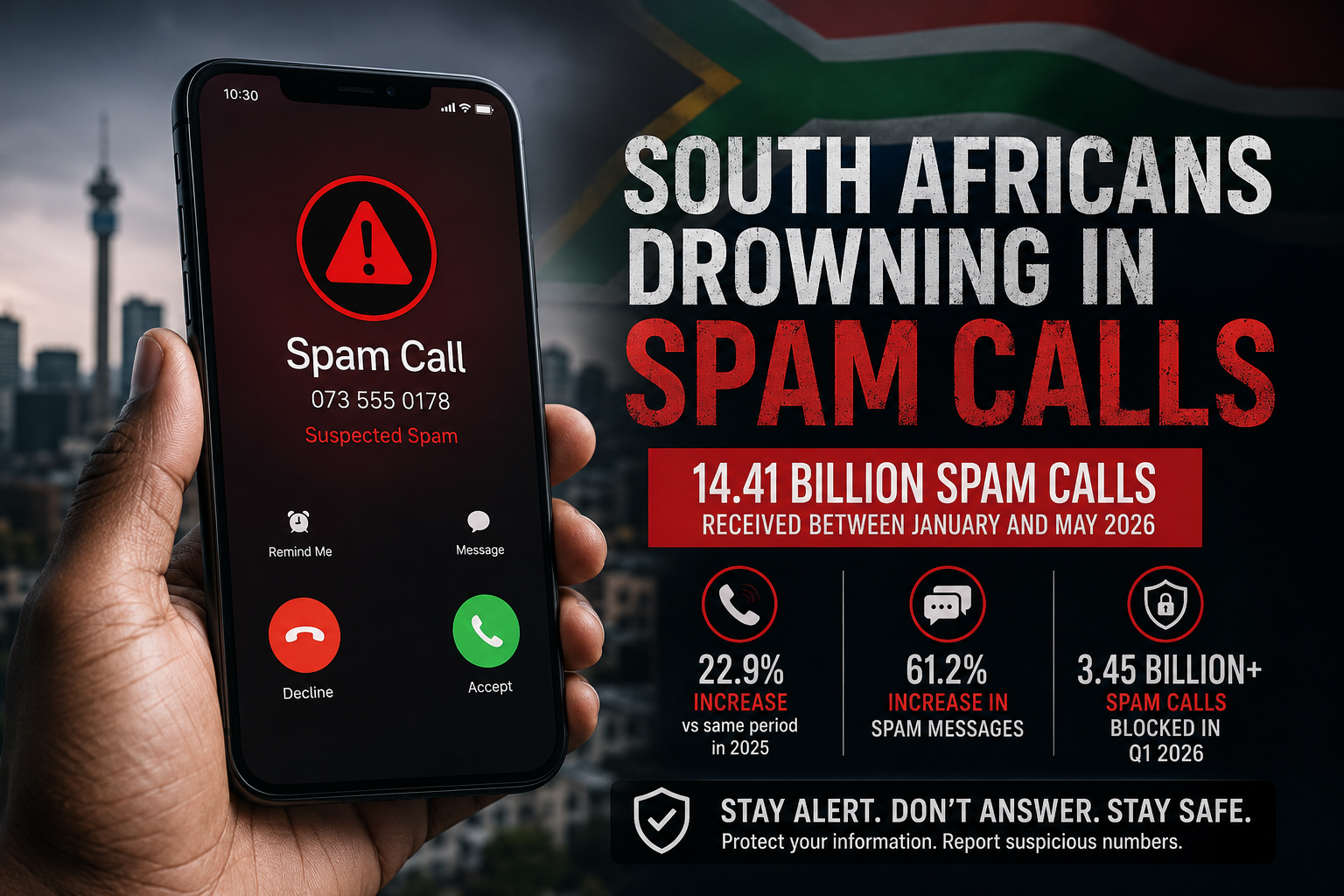
South Africans received an estimated 14.41 billion spam calls between January and May 2026, according to data from caller-identification company Truecaller. That represents a 22.9% increase compared with the same period in 2025.
The figures highlight the extraordinary scale of unwanted calls in the country, where consumers increasingly have to think twice before answering an unfamiliar number.
Billions of calls in just five months
Truecaller's figures show that spam-call volumes increased every month during the first five months of 2026.
January recorded approximately 2.58 billion spam calls, followed by 2.80 billion in February. March was particularly severe, with 3.33 billion calls, representing a 34.3% increase compared with March 2025.
April recorded 2.74 billion calls, while May added another 2.96 billion.
Combined, the five-month total reached 14.41 billion spam calls, up from 11.73 billion during the same period in 2025.
The problem was already severe in 2025, when South Africans received an estimated 30.3 billion spam calls over the course of the year.
It's more than just an annoyance
Spam calls are not simply an inconvenience. Increasingly, criminals are using phone calls as an entry point for fraud, impersonation and social engineering.
A caller may pretend to represent a bank, insurance company, cellphone provider or government department before attempting to obtain sensitive information such as an OTP, PIN, password or banking details.
Truecaller's data also suggests that the nature of unwanted calls is changing as technology becomes more sophisticated.
South Africa recorded a 30% spam intensity rate in Truecaller's 2025 global analysis, meaning roughly three out of every 10 calls from unknown numbers were classified as spam.
Spam messages are rising too
The problem is not limited to voice calls.
Truecaller reported that spam messages in South Africa increased by 61.2% during January to May 2026 compared with the same period a year earlier.
That creates another avenue for criminals to target consumers through fake banking alerts, delivery notifications, investment opportunities and links designed to steal personal information.
Authorities are fighting back
The growing problem has also attracted the attention of South African regulators.
In April 2026, amendments to the Consumer Protection Act regulations were published, strengthening mechanisms aimed at dealing with unwanted direct marketing and telemarketing.
The Information Regulator has also been pursuing complaints involving direct telemarketing, with several matters escalated to its Enforcement Committee.
Despite these efforts, the latest numbers suggest that the volume of unwanted calls remains extremely high.
Blocking is increasing
There is at least one encouraging trend: South Africans are becoming more aggressive about blocking unwanted callers.
Truecaller reported that blocked calls increased 28.1% year-on-year, with the proportion of identified spam calls that were blocked rising from 39.3% to 40.9%.
During the first quarter of 2026 alone, more than 3.45 billion spam calls were blocked, according to Truecaller's South African data.
But the sheer volume means that blocking individual numbers is often a losing battle. Scammers can rapidly switch numbers, use automated systems and exploit internet-based calling services.
What South Africans should do
Consumers should be particularly cautious when an unexpected caller creates a sense of urgency.
Never provide an OTP, banking PIN, password or other sensitive information simply because someone claims to represent your bank or another organisation.
If a caller claims to be from a legitimate company, hang up and contact the organisation using a number obtained independently from its official website, app or statement.
South Africans should also avoid clicking suspicious links received through SMS or messaging platforms and should report fraudulent numbers where possible.
The reality is that unknown calls can no longer automatically be treated as harmless marketing.
With billions of unwanted calls being generated every year, South Africans are increasingly having to treat their phones as another frontline in the fight against digital fraud.
And as scammers adopt automation and artificial intelligence, the battle between legitimate communication and unwanted calls is likely to become even more sophisticated.